

WELCOME TO THE LLU MASTER'S OF OCCUPATIONAL THERAPY BRIDGE PROGRAM
The MOT-Bridge program offers a unique blend of primarily hybrid learning with on-campus and fieldwork experiences spanning 7 quarters. This program is designed for practicing Occupational Therapy Assistants (OTAs) and Physical Therapy Assistants (PTAs) seeking to advance their careers by earning a Master in Occupational Therapy (MOT).
This is a valuable opportunity for OTA and PTA practitioners to explore community-based settings and engage in evidence-based clinical practice through the lens of research and critical inquiry. The MOT program equips graduates to make a positive impact in their careers, while also earning a Wellness Coaching Certification, with a focus on wellness promotion, health equity, interprofessional collaboration, occupation-centered, evidence-based care.
Graduates will be eligible to sit for the National Board for Certification in Occupational Therapy (NBCOT) exam for occupational therapists. The program integrates exam preparation into core courses, ensuring readiness. Upon successfully passing the NBCOT exam and completing all program requirements, including didactic and experiential components, students will earn the Occupational Therapist, Registered (OTR®)
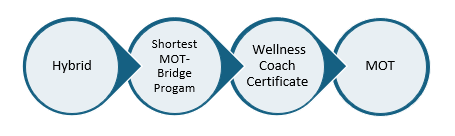
OTA-PTA Bridge Program to MOT
Program Overview
- Graduated from an AOTA accredited OTA or CAPTE accredited PTA program
- Current OTA or PTA license in good standing with home state of practice
- At least 1 year of full-time practice as a COTA or PTA (equivalent to 1500 hours/avg 30 hrs. per week or more)
- Bachelor's Degree
- GPA 3.0
- A grade of B and above required for all prerequisite courses. Grades below a B- will not be accepted: (no time limit)
Prerequisites
- Human Anatomy with Lab
- Human Physiology with Lab
- Human Lifespan Development
Admissions Information
For further admissions and policies information:
Year 1
Year One | Courses | Units |
| OTBR 500 | Professional Foundations | 4 |
| OTBR 504 | Functional Neuroscience | 4 |
| OTBR 505 | Conditions in OT: Ortho | 3 |
| OTBR 506 | Analysis & Intervention: Ortho | 1 |
| OTBR 508 | Splinting | 1 |
| OTBR 514 | Physical Agent Modalities | 1 |
| OTBR 509 | Conditions in OT: Beh Health | 3 |
| OTBR 510 | Analysis & Intervention: Beh Health | 1 |
| OTBR 524 | Conditions in OT: Neuro | 3 |
| OTBR 525 | Analysis & Intervention: Neuro | 1 |
| OTBR 701 | Level 1 FW-Psychosocial | 1 |
| HPRO 526 | Lifestyle Diseases & Riss Red | 3 |
| OTBR 507 | Design & Technology | 1 |
| OTBR 515 | Conditions in OT: Inf/Child/Yth | 3 |
| OTBR 516 | Analysis & Intervention: Inf/Child/Yth | 1 |
| OTBR 517 | Intro to Sensory Processing | 1 |
| OTBR 574 | Critical Inquiry & EBP I | 3 |
| OTBR 702 | Level 1 FW- Pediatric | 1 |
| HPRO 541 | Wellness Coaching I | 3 |
Year Two | Courses | Units |
| OTBR 518 | Intro Neuro Theories & Tech | 1 |
| OTBR 519 | Conditions in OT: Gen Med | 3 |
| OTBR 520 | Analysis & Intervnetion: Gen Med | 1 |
| OTBR 575 | Critical Inquiry & EBP II | 3 |
| OTBR 703 | Level 1FW- Phys Dys | 1 |
| HPRO 542 | Wellness Coaching II | 3 |
| OTBR 560 | Business & Management | 3 |
| OTBR 564 | Leadership & Advocacy | 3 |
| RELE 564 | Ethics & Health Disparities | 3 |
| OTBR 711 | Level II FW 1 | 8 |
| OTBR 712 | Level II FW 2 | 8 |
The Master of Occupational Therapy (MOT) is a Bridge Program at Loma Linda University which is accredited by the Accreditation Council for Occupational Therapy Education (ACOTE) of the American Occupational Therapy Association (AOTA), located at 7501 Wisconsin Avenue, Suite 510E, Bethesda, MD 20814. ACOTE can be reached via AOTA at (301) 652-AOTA, and more information is available at www.acoteonline.org. The next accreditation visit will be in Fall of 2026.
Graduates of the program are eligible to take the national certification exam for occupational therapists, administered by the National Board for Certification in Occupational Therapy (NBCOT). Upon passing the exam, individuals earn the title Occupational Therapist, Registered (OTR).
Licensure is required in all states to practice, and is typically based on the results of the NBCOT Certification Exam.
*Please note that a felony conviction may impact a graduate’s eligibility to take the NBCOT exam or obtain state licensure.
Data reported here is based on the 2023 ACOTE standard A.4.5. The NBCOT results may be seen at this link: https://www.nbcot.org/Educators-Folder/SchoolPerformance
Entry-Level MOT Loma Linda Test Takers Reported by NBCOT
| Year | Number of Test Takers | Number of Test Takers passing within a year | Percentage of test takers passing (May-Dec) |
| 2022 | 53 | 49 | *92% |
| 2023 | 45 | 45 | 100% |
| 2024 | 45 | 43 | 96% |
| 2025 | 2 | 1 | *50% |
*Of the last cohort from the Entry-level MOT graduating class of 2024, two graduates who followed a non-traditional progression through the program subsequently sat for the NBCOT certification examination, with one candidate successfully achieving passing status.
*This program is now an online OTA-PTA to MOT bridge with the first cohort graduating in June 2027.
*Please note the Class of 2022 and the Class of 2023 had a 100% pass rate (48/48 students in each graduating class).
Loma Linda University is above the national average in acceptance of a diverse group of students. Students come to Loma Linda University from multiple cultural backgrounds, religions, and countries. The table below is a report of graduation rates of the MOT program over the last three years.
| Graduation Year | Students Entering/Graduating | Graduation Rate |
| 2021 | 53/54 | +100% |
| 2022 | 50/48 | 96% |
| 2023 | 53/45* | 89% |
| 2024 | 47/51 | 92% |
| 2025 | *This program is now an online OTA to MOT bridge with the first cohort graduating in June 2027. | |
| Total | 203/198 | 94.25% |
*This program is now an online OTA-PTA to MOT bridge with the first cohort graduating in June 2027
*Some students took LOA due to health and personal reasons
GRADUATES OF THE PROGRAM WILL BE ELIGIBLE TO SIT FOR THE NATIONAL CERTIFICATION EXAMINATION FOR THE OCCUPATIONAL THERAPIST, ADMINISTERED BY THE NATIONAL BOARD FOR CERTIFICATION IN OCCUPATIONAL THERAPY (NBCOT®). AFTER SUCCESSFUL COMPLETION OF THIS EXAM, THE GRADUATE WILL BE AN OCCUPATIONAL THERAPIST, REGISTERED (OTR). IN ADDITION, ALL STATES REQUIRE LICENSURE TO PRACTICE; HOWEVER, STATE LICENSES ARE USUALLY BASED ON THE RESULTS OF THE NBCOT CERTIFICATION EXAMINATION. A FELONY CONVICTION MAY AFFECT A GRADUATE’S ABILITY TO SIT FOR THE NBCOT CERTIFICATION EXAMINATION OR ATTAIN STATE LICENSURE.”
View total cost of attendance, including current tuition and fees and the total cost of completing the program here. Published fees are subject to change.
View financial aid information here.
Mission
The Department of Occupational Therapy prepares compassionate, mission-driven practitioners who demonstrate excellence, integrity, and servant leadership. The program emphasizes evidence-based practice, whole-person care, and service at individual, community, and societal levels.
Philosophy
We believe humans are complex, spiritual, and occupational beings. Meaningful occupations are essential to identity, health, and well-being. Our approach promotes occupational justice, client-centered care, and active engagement with environments and contexts. Using occupation as both a means and an end, we holistically address mind, body, and spirit to empower individuals and communities.
Curriculum Design
Guided by the Global Model of Learning, our curriculum integrates faith, learning, and service to prepare students as professional practitioners. Students learn through active, layered experiences in class, fieldwork, and the community.
Foundation: Faith-based values and occupational therapy principles
Three Pillars:
Practice
Community Engagement & Leadership
Research
The Globe: Represents our global mission in service, advocacy, and wellness
Curricular Threads woven throughout the program:
Occupation-based Practice
Whole-person Care, Health Management, & Wellness
Evidence-based Practice & Research
Mission-focused Community Engagement & Service
Professional Citizenship & Advocacy